
What is Roman architecture style? When, where and how did it emerge? What are main characteristics of Roman structure? Here are ancient Roman architecture history, architects and famous Roman buildings…
Roman architecture is a unique building art that has influenced and inspired humanity for thousands of years. Notable not only for its majestic structures but also for its engineering marvels, Roman architecture forms the basis of modern architecture even today. Roman architecture also had a significant impact on urban planning, building materials and architectural aesthetics.
Contents
What is Roman Architecture?

Roman architecture is an architectural style that developed in and around the Mediterranean basin during the Ancient Roman period, from approximately the 1st century BC to the 4th century AD, and had a great influence on modern architecture. Notable not only for its magnificent structures but also for its engineering marvels, Ancient Roman architecture is known for its durability, size and functionality.
The widespread use of building materials such as concrete and arches allowed the Romans to build monumental structures with multiple floors and large interiors. The Colosseum, Pantheon and Roman Forum are among the most famous examples of Roman architecture. Building elements such as reinforced concrete, domes and arches are important elements inherited from Roman architecture. The effects of Roman architecture can still be seen in many modern buildings today.
Note: Don’t forget to read Architectural History from Prehistory to the Present to get brief information about architectural styles!
Ancient Roman Architecture History

Architecture of Roman Empire
When and where did it appear?
Roman architecture emerged and developed from the foundation of the Roman Republic in 509 BC to the 4th century AD. The center of this architectural style was the city of Rome in present-day Italy. However, with the expansion of the Roman Empire, this architectural style spread to many regions in and around the Mediterranean basin.
The origins of Roman architecture can be traced back to Etruscan architecture. The Etruscans were a pre-Roman civilization on the Italian peninsula and developed many building techniques and design elements that laid the foundations for Roman architecture. The Romans combined these techniques and materials they inherited from the Etruscans with other elements from Greece and created a unique architectural style as a result of their own original designs.

Ancient Roman architecture took the name “Christian architecture” with the official acceptance of Christianity in the 4th century AD. After the Roman Empire was divided into two, it was replaced by “Eastern Roman architecture”, also known as “Byzantine architecture”.
Why and how did it emerge?
Roman architecture emerged as a reflection of the political, social and economic power of Ancient Rome. The Romans’ conquest of vast territories and interaction with different cultures enriched their understanding of architecture. Thus, they created a new architectural style by combining building techniques and materials from neighboring civilizations such as the Etruscans with their own original designs.
Roman style architecture focused on features such as utilitarianism and monumentality rather than the search for ideal beauty of Greek architecture. The use of arches and vaults became widespread in Roman structure. This allowed for the construction of larger and more complex structures. In addition, Roman architecture was not limited to religious buildings, but also included structures open to public use such as theaters, baths and aqueducts.
Roman Architecture Style
Roman Period Architecture

The use of new materials and techniques together with the Romans’ engineering skills enabled the construction of large and complex structures. Concrete and brick were used as materials and arches and domes as structures. Thus, huge amphitheaters such as the Colosseum, domed temples such as the Pantheon and large forums such as the Roman Forum were built.
One of the main purposes of Roman architecture was to display the power and splendor of the empire. For this reason, Ancient Roman buildings were often large in size, ornate and durable. Roman period architecture also prioritized practicality and functionality. Water systems, such as aqueducts, enabled Roman cities to grow and prosper.
Main Characteristics of Roman Structure

The most significant characteristics of Roman architecture are the following:
- Size and Monumentality: Roman buildings were usually built in large sizes and in an impressive manner. Structures such as the Colosseum and Pantheon are the most striking examples of this feature.
- Durability and Functionality: The Romans widely used building materials and techniques such as concrete and arches. Thus, they ensured that the structures were both long-lasting and useful in daily life.
- Symmetry and Balance: Symmetry and balance were of great importance in Roman architecture. Buildings were usually built on a regular and balanced plan.
- Decorations and Sculptures: Roman buildings were enriched with various decorations and sculptures. These decorations often included mythological figures or themes of victory.

- Use of Arches and Domes: Arches and domes are the most characteristic features of Roman structure. These building elements enabled the covering of large openings and allowed for the construction of more complex structures.
- Use of Concrete: The Romans took an important step in the use of concrete as a building material. Concrete gave structures both durability and flexibility.
- Aqueducts: The aqueducts built for water supply in Rome are recognized as engineering marvels. These arches were used to carry water to long distances to meet the water needs of cities.
Ancient Roman Buildings
Ancient Rome is a unique civilization that has influenced and inspired humanity for thousands of years. One of the greatest legacies of this civilization has undoubtedly been its architecture. The magnificent structures of Rome have survived to the present day as both engineering marvels and aesthetic masterpieces. These buildings are not only of aesthetic value, but also provide important information about the lifestyle, beliefs and technology of ancient Roman society. Here are the most famous Ancient Roman buildings:
1. Colosseum

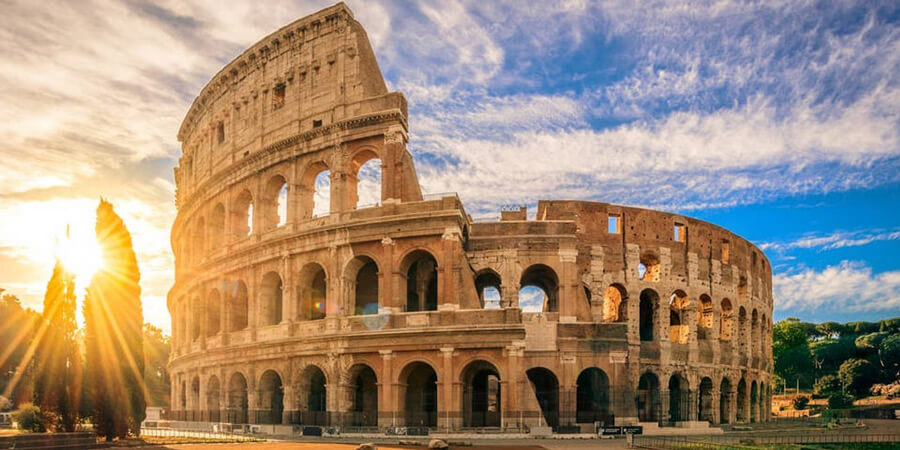
The Colosseum, which has become the symbol of Rome, is a huge amphitheater where gladiator fights and other shows were held. With its oval shape and its structure made of stone and concrete materials, it was a great engineering achievement for that period.
This oval structure has the capacity to accommodate approximately 50,000 spectators. The exterior of the building is covered with large travertine blocks. The interior is divided into tiers where the spectators are seated according to different social classes. On the floor of the Colosseum is the arena where shows such as gladiator fights and wild animal hunts were held. In the lower part of the building, there are tunnels and cages where animals and gladiators were brought to the arena.
The building materials such as concrete and arches used in the period when the Colosseum was built made the structure both durable and able to cover large openings. This made it possible to build a very large and complex structure for the time. The architecture of the Colosseum shows not only the power and splendor of the Roman Empire, but also how advanced the engineering skills of the ancient world were.
2. Pantheon

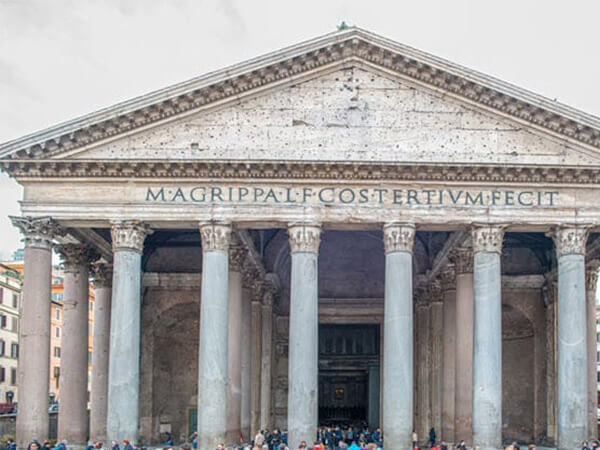
Famous for its perfect spherical dome, the Pantheon is one of Rome’s most iconic and best-preserved ancient Roman temples. Built using concrete, the massive dome is considered an extraordinary feat of engineering for the time. A large opening in the center of the dome, called the oculus, allows natural light into the interior and gives the building a mystical aura.
The interior of the Pantheon is built on a circular plan, enriched with niches and columns along the walls rising towards the dome. Moreover, the Pantheon’s perfect proportions and symmetrical structure give the building a timeless beauty. More than just a temple, this Roman structure is a marvel of engineering and art, representing the pinnacle of ancient Roman architecture.

3. Roman Forum
The Roman Forum, considered the heart of Rome, was the center of political, social and commercial life. There are many types of buildings here, such as temples, basilicas, arches, columns, statues and monuments. Therefore, its architecture reflects this complex and multifaceted function.

The architecture of the Roman Forum developed continuously over time and during different imperial periods. Therefore, rather than speaking of a single architectural style, it would be more accurate to speak of a complex structure formed by the combination of various structures.
The buildings in the Forum are usually located in open-air areas and are in visual relationship with each other. These buildings have the characteristic features of Roman architecture such as symmetry, proportion and the use of columns. In addition, the buildings in the Forum were built to commemorate important events and people in the religious, political and social life of Roman society.
4. Palatine Hill
Palatine Hill, one of the seven hills of Rome, was home to the homes of the rich and powerful citizens of ancient Rome. On this hill are the ruins of imperial palaces and other important buildings.

The buildings on the Palatine Hill have constantly changed and evolved over time and during different imperial periods. Therefore, it is difficult to describe the architecture of the hill in a single style. In general, however, the buildings on the Palatine Hill are luxurious, opulent and complex. There are imperial palaces, villas, gardens and various auxiliary buildings.
These buildings often have features characteristic of Ancient Roman architecture, such as symmetry, proportion and the use of columns. In addition, the buildings were decorated with rich ornamentation, mosaics and sculptures. The Palatine Hill, a reflection of the sumptuous and luxurious life of the Roman Empire, provides important information about the social and political structure of Roman society.
5. Trajan’s Column

Trajan’s Column is a monumental structure built to commemorate the Dacian victories of the Roman Emperor Trajan. Used both as a monument and a propaganda tool, the column is located in the Roman Forum. Trajan’s Column is an important reflection of Rome’s culture of victory and empire.
The 38-meter-high column consists of 19 cylindrical drums made of Italian white marble. The most striking feature of the column is the detailed reliefs surrounding its shaft, depicting Trajan’s Dacian campaigns. These reliefs are among the most important examples of Roman art, depicting scenes of daily life as well as battle scenes. At the bottom of the column are the ashes of the emperor. At the top of the column there used to be a statue of Trajan.

6. Pont du Gard
The Pont du Gard in Nîmes, France, is a huge aqueduct built during the Roman Empire and has survived to the present day. The three-story aqueduct is an important structure that shows how water was transported in ancient Rome.

Pont du Gard is not only an aqueduct, but also a three-story bridge. The arched structure on the lower level allows you to cross over the river. The middle and upper levels support the canals that carry the water. Stones used in the construction of the Pont du Gard were meticulously hewn and pieced together, allowing the structure to stand for thousands of years.
A testament to Roman engineering skills, Pont du Gard also provides important information on water management and construction techniques. This magnificent structure is one of the best preserved Roman aqueducts.
7. Maison Carrée

Considered one of the most perfect examples of classical Roman architecture, Maison Carrée is located in Nimes, France. The building is a Roman temple that has survived almost undamaged.
The temple is a perfect example of the classical Tuscan architecture mentioned by Vitruvius in his “Ten Books on Architecture”. This means that the building has a single cella (cult chamber), a deep loggia, a frontal, axial orientation and sits on a high podium. The facade of the Maison Carrée has a deep portico or pronaos, which makes up almost 1/3 of the temple. The architrave above the columns is divided into three sections with 1:2:3 proportions by a drip frieze. If you look at Maison Carrée, its deep portico, its high podium, its façade emphasis, you see all the elements of Roman architecture.
In short, Maison Carrée reflects the main characteristics of classical Roman architecture with its perfect proportions, simple and elegant design. The building is well preserved, making it an important resource for architectural historians and enthusiasts.
Note: This list is just a few of the countless buildings of Rome. Roman architecture can be found in many cities and countries around the world.
To discover other Ancient Roman buildings in Rome: Things to Do in Rome (Ultimate Travel Guide)
Ancient Roman Architects

Architecture in ancient Rome was not only the process of building a structure, but also a mirror of society and culture. Although many talented architects contributed to the rise of this great empire, individual architects were not as highly regarded as they are today. Major construction projects were often funded by emperors or wealthy patrons, and architects often worked as part of a team.
Also, due to the lack of record-keeping methods in antiquity, the names of many Roman architects have been lost to history. However, some architects have managed to stand out for their work and their influence on their times. Here are some of the most important architects of Ancient Rome:
Vitruvius:

Vitruvius, known as Marcus Vitruvius Pollio, is one of the most important architects and engineers of the ancient Roman period. Architect Vitruvius, who lived in the 1st century BC, is especially known for his work “De Architectura” (Ten Books on Architecture). This work is considered one of the most important texts in the history of Western architecture and has inspired architects for centuries.
In his work “De Architectura”, Vitruvius argues that a building should be based on three basic principles: firmitas (solidity), utilitas (usefulness) and venustas (beauty). These three principles mean that a building should be solid, useful and aesthetic. Vitruvius was concerned not only with the technical aspects of building, but also with its aesthetic and social dimension. In his work, he emphasizes that architecture should be in harmony with nature and that a building should be built in accordance with its surroundings.
Vitruvius’ “De Architectura” covers many different fields, not only architecture, but also engineering, mathematics and even philosophy. In his work, he touches on many different topics such as aqueducts, clocks, machines and gives important information about the technological developments of the period. Vitruvius was rediscovered by Renaissance architects and became an important turning point in the history of architecture. Even today, his works are used as an important reference source in architectural and engineering education.
Related Articles: Renaissance Architecture (Characteristics & Examples)
Appius Claudius Caecus:

Appius Claudius Caecus (4th century BC) was a prominent statesman of the Roman Republic, known especially for his contributions to architecture and engineering. Elected consul in 312 BC, Appius Claudius led the construction of the Aqua Appia, Rome’s first major aqueduct. This aqueduct was the first major infrastructure project to bring water to the city and played a critical role in the growth and development of Rome.
Appius Claudius also initiated the construction of the famous Via Appia (Appius Way), which bears his name. This road, which ran from Rome south to Capua, was strategically important in the expansion of the Roman Empire. The work of Appius Claudius Caecus contributed greatly to Rome’s advances in engineering and infrastructure, and his legacy lives on in Roman roads and water systems throughout the centuries.
Marcus Vipsanius Agrippa:

Marcus Vipsanius Agrippa (64-12 BC) is known as Augustus’ closest friend and one of the most talented generals of the early Roman Empire. He was distinguished not only for his military achievements but also for his great projects in architecture and engineering. Agrippa contributed greatly to the development of Rome’s water and sewage systems and built many aqueducts and baths that supplied water to the city.
Agrippa’s most famous work is the Pantheon, first built in 27 BC. Although the original structure was destroyed and rebuilt under Hadrian, Agrippa’s name is synonymous with this architectural masterpiece. Agrippa also made significant contributions to Rome’s urban planning and infrastructure, building many public buildings and baths on the Campus Martius. His vision and engineering achievements played a major role in Rome becoming a world capital.
Ancient Roman architecture has produced some of the most impressive and enduring structures in history. Shaped by the brilliance of architects and engineers, these structures are among the touchstones not only of Ancient Rome but also of world architectural history. Even today, they continue to inspire modern architecture, demonstrating that Rome’s architectural genius and aesthetic sense left a legacy that will last for generations.
Don’t forget to read Architectural History from Prehistory to the Present to get brief information about architectural styles!
